
MVT DD12 vs DD21 for Minarelli AM6: what is the real difference?
By Petrogalli staff
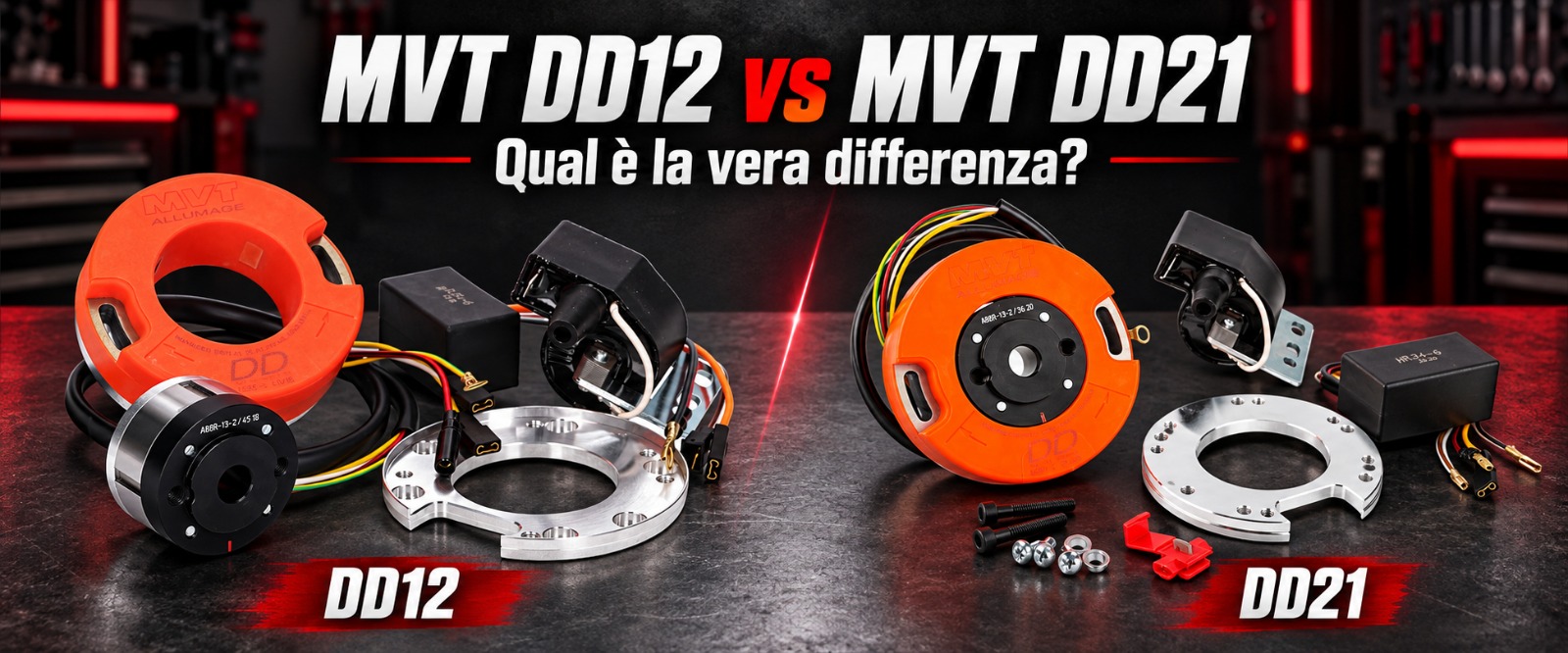
The MVT Digital Direct DD12 and the MVT Digital Direct DD21 are often presented as two ignitions of different levels: some consider the DD21 newer or more powerful, others think the name simply depends on the year of the engine. In reality, neither interpretation is correct.
Both belong to the same MVT Digital Direct family, both are digital variable-advance ignitions with an internal rotor, and both retain a lighting output. The fundamental difference is not the stated performance but the application: the DD12 is the version intended for Minarelli AM6 engines in general, excluding the specific MBK and Yamaha systems from 2003 onwards; the DD21 is the variant dedicated to precisely those MBK/Yamaha models from 2003 onwards.
Short answer
- MVT DD12: for bikes with a Minarelli AM6 engine, including MBK/Yamaha models built before 2003, but excluding MBK/Yamaha applications from 2003 onwards.
- MVT DD21: for MBK/Yamaha AM6 applications from 2003 onwards, among which MVT lists the Yamaha DT/DTR and TZR and the MBK X-Limit and X-Power.
- Stated performance: identical in the MVT product sheets.
- Components: the rotor is shared, but the stator and ignition module have different part numbers.
- Right choice: based on make, model, year of manufacture and original electrical system, not simply on the fact that the engine is an AM6.
Technical comparison of MVT DD12 and MVT DD21
| Feature | MVT DD12 | MVT DD21 |
|---|---|---|
| Type | Digital variable advance, internal rotor | Digital variable advance, internal rotor |
| Stated lighting output | 55 W | 55 W |
| Stated spark voltage | 42 kV | 42 kV |
| Stated maximum ignition rpm | 22,000 rpm | 22,000 rpm |
| Operating range stated by MVT on racing engines | 7,000–15,000 rpm | 7,000–15,000 rpm |
| CNC internal rotor weight | 250 g | 250 g |
| Spare rotor | RT12DD | RT12DD |
| Spare stator | ST12DD | ST21DD |
| MVT standard digital module | RJ34/61 | RJ34/82 |
| Optional multi-curve ECU | EPROM1 | EPROM5 |
| Main application | AM6, excluding MBK/Yamaha from 2003 | AM6 MBK/Yamaha from 2003 |
| Kit EAN code | 3701674301604 | 3701674304827 |
The common data shown in the table come from MVT's official product sheets for the DD12 and DD21.
The stated performance is the same
MVT gives both ignitions a 55 W lighting output, a spark voltage of 42 kV, a maximum of 22,000 rpm, a racing operating range of 7,000 to 15,000 rpm and a 250-gram CNC internal rotor.
Consequently, there is no official figure that would allow the DD21 to be presented as more powerful, faster or better suited to tuning than the DD12. The DD21 is not an “upgrade” of the DD12: it is a version designed for a different electrical system.
It is equally important, however, not to claim that the two ignitions are identical in every detail. The supplied digital modules have different part numbers, and in the product sheets consulted MVT does not publish a full comparative chart of the two advance curves. The technically correct statement is therefore this: the DD12 and DD21 have the same stated performance characteristics, but different electrical components and applications.
The 22,000 rpm figure is also the stated limit of the ignition, not the rpm that any AM6 engine can safely reach. The engine's real limit depends on the cylinder, crankshaft, con rod, bearings, balancing, lubrication and overall configuration.
The practical difference: stator, digital module and wiring
The clearest evidence of the difference can be found in the MVT spare parts catalogue.
The rotor is shared: MVT sells the RT12DD rotor specifically for both the DD12 and the DD21. This confirms that the two versions share the main mechanical component fitted to the crankshaft.
The stator, on the other hand, is different:
- the DD12 uses the ST12DD stator;
- the DD21 uses the ST21DD stator, listed for the MBK/Yamaha X-Power, TZR and DT from 2003 onwards.
The digital module that manages the ignition, called the “diagramme” in the MVT catalogue, is also different:
- the DD12 uses the RJ34/61 module;
- the DD21 uses the RJ34/82 module, specific to MBK/Yamaha AM6 engines from 2003.
The wiring diagrams are different too. The DD21 manual shows integration with the original four-way connector and the CDI circuit of the MBK/Yamaha models concerned, while the DD12 manual shows a different wiring diagram. For this reason, the two versions should not be considered interchangeable “colour for colour”, and the DD12 diagram must not be used to fit a DD21, or vice versa.
Why are there two versions if the engine is always a Minarelli AM6?
The engine name mainly describes the mechanical base; it does not guarantee that all bikes fitted with an AM6 have the same original stator, the same connectors, the same kill circuit or the same management of the electrical accessories.
From 2003, MVT distinguishes the systems fitted to certain MBK and Yamaha models from those of other AM6 applications. The DD21 therefore adapts the Digital Direct to that specific electrical architecture. It is not the AM6 engine itself that requires the DD21: it is the bike model and its electrical system.
This also clears up a very common misconception: an AM6 bike built after 2003 does not automatically require the DD21. A Beta, a Rieju, a Sherco or any other post-2003 AM6 application normally remains within the scope of the DD12 according to MVT's classification; the 2003 threshold concerns the specific MBK/Yamaha family indicated by the manufacturer.
Which one should you choose?
The practical rule, in line with the MVT catalogue, is as follows:
Choose the MVT DD12 if
- the bike has a Minarelli AM6 and is not one of the MBK/Yamaha applications from 2003 listed by MVT;
- it is an MBK or Yamaha AM6 built before 2003;
- the MVT application catalogue explicitly links your model to the DD12 reference.
Choose the MVT DD21 if
- the bike is a Yamaha DT/DTR or TZR with the system adopted from 2003 onwards;
- the bike is the equivalent MBK X-Limit or X-Power from 2003 onwards;
- the MVT application catalogue or the original part number confirms the DD21 reference.
Do not base your choice solely on
- the “Minarelli AM6” marking on the engine;
- the year of first registration;
- the shape or colour of the rotor;
- the idea that the number 21 indicates a higher-performance version.
Close to the 2003 changeover, it is wise to check the actual year of manufacture, the exact model and the connectors on the original stator. A bike registered in 2003 or 2004 may in fact belong to a series produced earlier; likewise, a replaced engine or a modified wiring loom means that checking the registration document alone is not enough.
What if the engine has been swapped or the wiring modified?
With an engine swap, a frame fitted with a different engine or a rebuilt wiring loom, you cannot choose correctly using the engine code alone. You need to identify at least:
- the make and model of the frame;
- the year or production series;
- the type of stator and connectors fitted;
- the wiring diagram of the kill circuit and accessories;
- the part number of the MVT module you intend to use.
In these cases it is best to give the dealer or MVT clear photos of the connectors and the full details of the bike. Mixing the stator, module and wiring loom from two different kits without technical confirmation from the manufacturer is not a documented procedure.
Ignition timing: the values stated by MVT
For the standard digital module, MVT gives the same basic timing for both versions:
- 0.40 mm before TDC with a standard-stroke crankshaft;
- 0.35 mm before TDC with a long-stroke crankshaft.
With the optional MVT multi-curve ECU, the stated value becomes 2.9 mm before TDC. However, the correct optional ECU is not the same: MVT pairs the EPROM1 with the DD12 and the EPROM5 with the DD21.
The 2.9 mm value must therefore not be applied to the standard module. Before fitting, always identify the module actually present and follow the instructions for that specific revision of the kit. Both manuals also stress the need for proper ventilation of the ignition area: this too must be done according to MVT's instructions, taking into account the protection against water and dirt required by the way the vehicle is used.
The DD12 and DD21 names do not indicate voltage or power
The number 12 does not mean “12 volts”, and the number 21 does not mean 21 watts, a second generation or a higher level. They are application codes within the MVT range. This is confirmed by the fact that both product sheets list the same 55 W lighting output and the same main performance specifications.
Frequently asked questions
Does the MVT DD21 give more horsepower than the DD12?
Not according to the official specifications. MVT states the same values for both and does not publish a dyno comparison showing any performance advantage for the DD21. The choice should be based on compatibility.
Can I fit a DD12 to a 2003-on Yamaha or MBK by adapting the wires?
This is not the solution intended by MVT. The stator and digital module have different part numbers and the wiring diagrams do not match. For the MBK/Yamaha applications from 2003 listed by the manufacturer, the DD21 should be used.
Can I fit the DD21 to a post-2003 Beta or Rieju AM6?
The year alone does not justify the DD21. MVT lists the DD12 for Minarelli AM6 engines, excluding the specific MBK/Yamaha models from 2003. The exact application of each individual model should still be checked.
Are DD12 and DD21 spare parts interchangeable?
Only some of them. The RT12DD rotor is shared; the ST12DD and ST21DD stators and the RJ34/61 and RJ34/82 modules are specific. Before buying any spare part, check the full MVT part number.
Does the 55 W lighting output make the ignition road-legal?
No: having a lighting output and being homologated for road use are two different things. Compliance depends on the vehicle, the installation and the applicable regulations; the 55 W figure alone does not prove homologation.
Conclusion
The real difference between the MVT DD12 and the MVT DD21 for the Minarelli AM6 is compatibility with the bike's electrical system. The stated performance, rotor weight and lighting output are the same; what changes is the stator, the digital module, the wiring and the compatible electronic accessories.
In a nutshell: DD12 for AM6 engines in general, including pre-2003 MBK/Yamaha models; DD21 for the specific MBK/Yamaha AM6 models from 2003 onwards. If the bike is close to the changeover year or has been modified, the exact model and the original wiring must be checked before buying.