
VForce3 vs VForce4X: what is the real difference between the two reed valves?
By Petrogalli staff
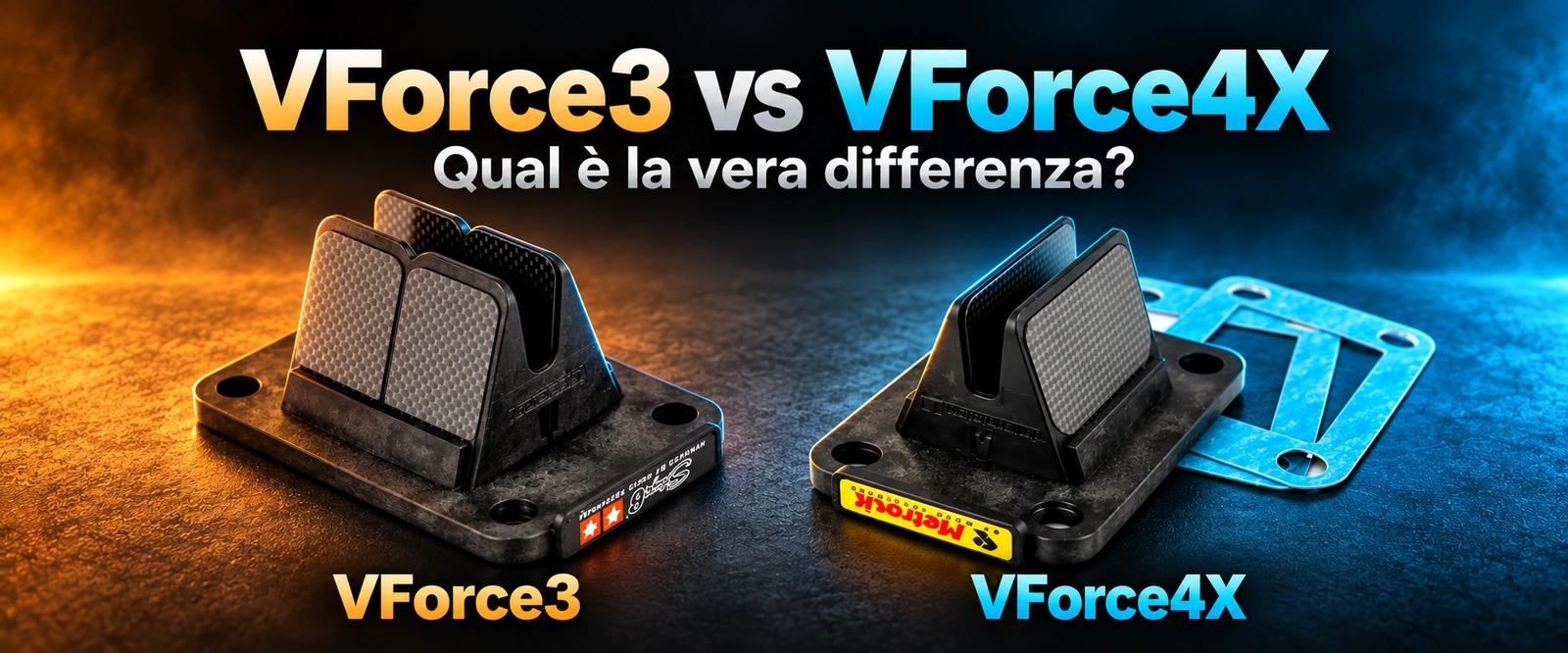
In a two-stroke engine, the reed valve controls the flow of the fuel–air mixture into the crankcase: the reed petals open when the pressure difference allows and limit backflow when the pressure reverses. Their response, together with the shape of the intake passages, can affect how the engine delivers its power. To understand what really changes between the VForce3 and the VForce4X, you need to compare versions designed for the same application, not features taken from products of a different displacement or generation.
What the VForce3 already offers
The VForce3 is not a conventional reed valve. Its design increases the total length of free reed edges compared with a traditional reed block; according to Moto Tassinari, this means the petals have to travel less to achieve a given effective opening. The manufacturer links this solution to better intake efficiency and less wear than a conventional design. It also points out that the petals can be replaced without fixing screws.
This is the starting point for the comparison: the larger reed edge area is a feature of the VForce3 compared with traditional reed valves, not an exclusive advantage of the VForce4X over the VForce3. Likewise, it cannot be inferred from this feature that the engine draws in twice as much air.
What changes in the VForce4X
For the version considered here, Moto Tassinari lists three changes compared with the VForce3: a new reed cage, a new airflow guide and a different petal combination. It is therefore an upgrade of the whole assembly that manages the passage of the mixture and the work of the petals, not just a replacement of the petals themselves.
The “X” designation also reflects a specific design choice: Moto Tassinari explains that it developed a new reed seating surface and petal combination with the aim of extending their service life, avoiding the rubber overmoulding stage used on the VForce4R series. This explanation relates to the VForce4X design; it is not a measurement of its durability compared with the VForce3.
Where the performance advantage lies
In the specific product sheet for the VForce4X, the manufacturer claims increased power from mid to high revs and a greater ability to keep revving beyond peak power (over-rev) compared with the VForce3. This is the performance difference Moto Tassinari highlights for this comparison. In the same sheet, it does not claim a measured gain at low revs, nor does it give a power percentage that applies to every engine.
The result you actually feel also depends on the condition of the petals being replaced, the engine configuration and the intake set-up. It would therefore be wrong to promise a fixed number of horsepower or to claim that the VForce4X always improves response at every rev range. To quantify the gain on a specific bike, you would need a comparative test carried out under the same conditions.
Durability, spare parts and making the right choice
The petals remain wear parts in both versions. Moto Tassinari recommends checking them at least once a season, and more often for high-rev use or on modified engines; signs to look for include chipping and fraying at the edges and corners. The manufacturer's instructions give the replacement procedure for both families.
If a VForce3 is working properly, switching to the VForce4X makes sense mainly for riders seeking the benefit the manufacturer places in the mid-range, at high revs and in over-rev. If, on the other hand, the existing petals are worn, bear in mind before judging the difference between the two products that the comparison would be skewed by the condition of the part removed. In any case, before buying you must check compatibility with the version and year of your engine and identify the spare parts intended for the series actually fitted. Moto Tassinari keeps separate spare parts catalogues for the VForce3 and the VForce4X.
In short: the VForce3 already has the VForce intake principle; the VForce4X changes the cage, the air guide and the petal combination. In this specific comparison, the advantage claimed by the manufacturer mainly concerns the mid-range, high revs and over-rev. The size of the gain and the relative durability are not figures that can be stated correctly without a test on the same engine under the same conditions of use.